




Some projects have a very clear beginning and end; others have a habit of coming back around.
In 2024, our team at Make created Speak Now as part of Taylor Town, Liverpool’s city-wide cultural programme celebrating the arrival of Taylor Swift and the Eras Tour. It was art inspired by music.
Two years later, it came back to us with a new brief. This time, the artwork wouldn’t simply be responding to music: the music was coming to it.
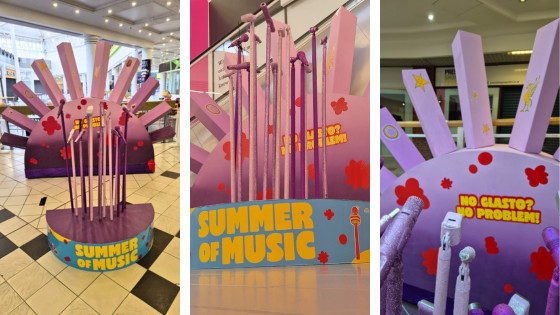
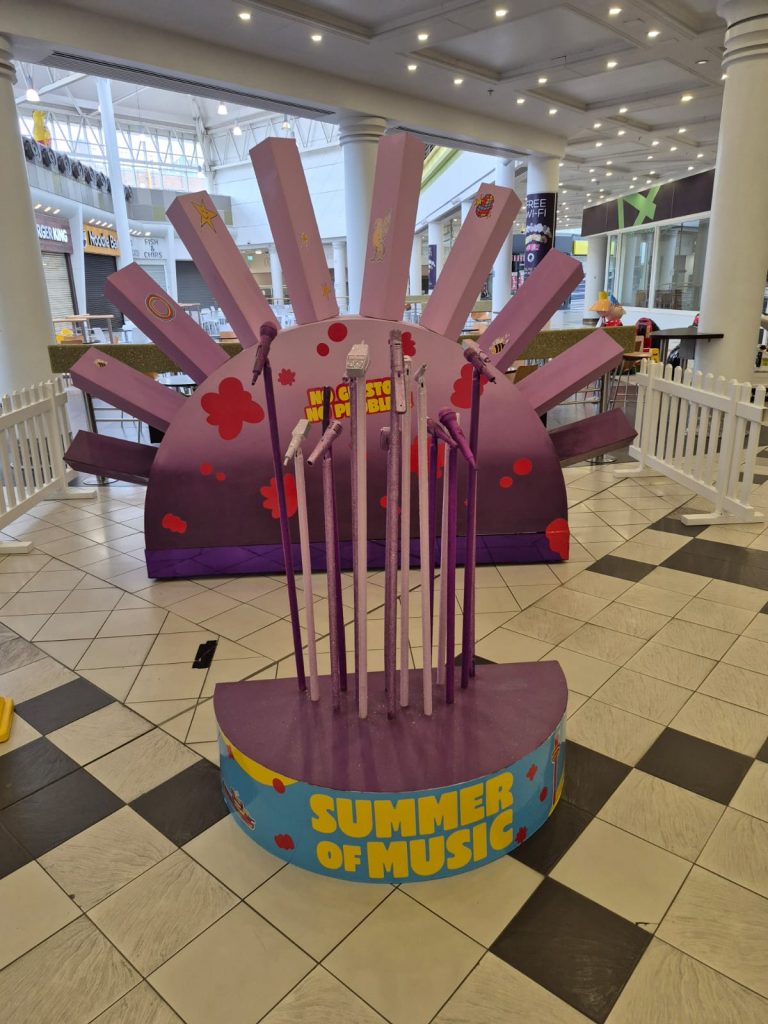
This summer, the Speak Now installation was reworked as part of Liverpool Summer of Music, delivered by Culture Liverpool and Sound City. The programme took music into towns and communities across the Liverpool City Region, with the installation travelling through Liverpool, Birkenhead, Prescot, Bootle, and Widnes. We removed its Taylor Town identity, gave it a new visual treatment, and prepared it for a summer on the road.
But the transformation wasn’t really complete until people arrived.
Across the programme, the installation became a backdrop for live performances and creative activity. One of our favourite moments was seeing Michael Aldag perform at Metquarter. Suddenly, something our makers had built as a piece of visual art had become a stage. People gathered around it. Shoppers stopped. Music filled a space normally occupied by the rhythms of an ordinary shopping day.
Art had met music, and both had landed somewhere slightly unexpected.
We’re used to the idea that we go somewhere specifically to experience culture. Music happens in a venue. Art happens in a gallery. Performance happens in a theatre. Except, of course, it doesn’t have to.
There’s something completely different about encountering creativity when you weren’t necessarily looking for it. You might have gone out for a coffee and found a live band. Gone shopping and encountered an installation. Walked through somewhere you’ve passed a hundred times before and discovered people making, performing, or dancing. You haven’t crossed the threshold into a designated cultural space; culture has crossed into yours. And we think there’s something valuable in that exchange.
Liverpool Summer of Music allowed us to watch it happen repeatedly, in very different places. Each location changed the installation and the activity around it. The artwork was the same. The people weren’t. The surroundings weren’t. The atmosphere wasn’t. And that meant the experience wasn’t either.
Make has always been quite comfortable in the spaces between things. We’re not a gallery, although artists work here. We’re not a traditional venue, although performances happen in our buildings. We’re not simply a workshop, although things are being designed, cut, painted, printed, sewn, and built here every day. Our work tends to happen where those things overlap:
- Artists working with fabricators
- Businesses working with makers
- Communities working with designers
- Culture meeting public space
Increasingly, we’re interested in what happens when we deliberately create more of those collisions. Sometimes the most interesting cultural experiences don’t require another purpose-built space; they require us to look differently at the spaces we already have.
For a few weeks this summer, shopping centres and town centres became stages. But something else happened, too: the normal rules of those places shifted slightly. We like the temporary nature of that. Not every creative intervention needs to permanently transform a place. Sometimes it’s enough to change what happens there for an afternoon.
For Speak Now, there’s something particularly satisfying about where it ended up. It started life because music was coming to Liverpool, and an artwork was created in response to it. Two years later, we took that artwork apart, changed it, put it back together, and sent it travelling around the city region. Then musicians stood in front of it and started playing.
Music made the artwork. The artwork came back and made space for music. That’s a pretty lovely full circle.
Perhaps there’s something in that for the way we think about future creative projects, too. Art doesn’t always need to stay in galleries. Music doesn’t always need to stay in venues. And our everyday spaces don’t always need to serve the same purpose every day. Sometimes you can put the three together and see what happens.
We’d quite like to do more of that.